September 8, 2026
AI Is Changing the Future of Work – Is Pakistan’s Youth Ready? A quiet but massive shift is underway...

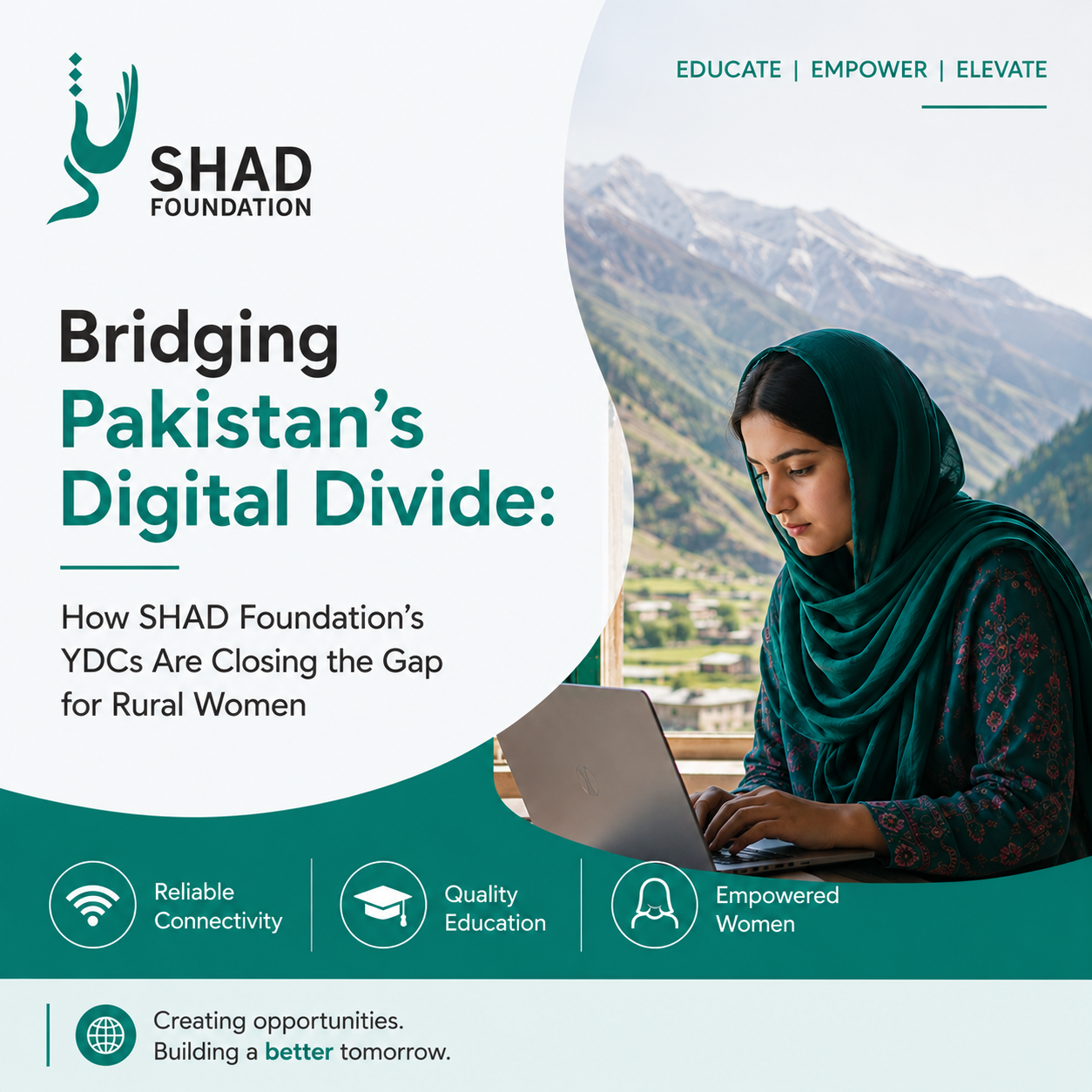
As Pakistan’s digital economy accelerates in 2026, a persistent spatial divide continues to threaten the academic and economic progress of youth in marginalized communities. While urban centers like Lahore and Karachi thrive on expanding 4G ecosystems and a growing digital workforce, rural regions, particularly northern territories like Chitral, remain constrained by infrastructure gaps, affordability barriers, and low digital literacy. For young women navigating higher education, this divide is not an abstract policy problem. It is the difference between finishing a degree and being locked out of it.
Pakistan now counts well over 117 million internet users, with national penetration above 45 percent of the population. On paper, that is real progress. But national averages hide a sharper regional story. More than 61 percent of Pakistanis live in rural areas, and rural connectivity continues to trail urban access by a wide margin. Independent connectivity trackers estimate that meaningful device-level internet access, not just occasional mobile signal, but reliable enough access to actually study, research, and complete coursework online, sits at roughly a third of the rate in rural areas compared with cities.
The infrastructure behind that gap is telling. Fixed broadband penetration nationally remains under two percent, and fiber-optic connections — the backbone needed for stable, high-speed internet — reach only a small fraction of telecom towers. Extending fiber to a village in Chitral or the wider northern belt is expensive, and private telecom operators, driven by return on investment, have historically concentrated rollout in dense urban markets. The result is a widening quality gap even where basic mobile coverage technically exists.
There is genuine good news on gender, however. Pakistan has recently posted the sharpest improvement in the world on the mobile internet gender gap, which industry data shows narrowing from roughly a quarter to single digits within a year, as millions more women came online. Yet ownership tells a more cautious story: Pakistan still has one of the widest mobile phone ownership gaps between men and women among comparable countries, and a large share of women who do go online do so on a borrowed device rather than one of their own. Shared access means less privacy, less consistency, and less ability to do the kind of sustained, focused work that a university course or a professional certification demands.
For a young woman from Chitral, Upper Dir, or another remote district, these three layers, thin rural infrastructure, tight household budgets, and inconsistent personal device access, stack on top of each other. Even a highly motivated student can find that the biggest barrier to her education isn’t ability, but access.
Higher education in Pakistan increasingly assumes digital access as a baseline: course portals, digital libraries, scholarship applications, career counseling platforms, and remote internship opportunities all now live online. For male students, moving to a city for university, sharing a flat, and finding an internet café or an affordable data plan is a manageable, if imperfect, workaround. For many young women, particularly those from conservative or resource-constrained households in the north, that same path is not available. Mobility restrictions, safety concerns, and financial constraints mean that leaving home for higher education is only possible when safe, structured accommodation exists at the destination.
This is where the digital divide and the gender gap in education compound each other. A female student who cannot safely relocate for university is also, by extension, cut off from the digital literacy training, career mentorship, and networked opportunities that increasingly determine post-graduation outcomes. Closing the connectivity gap in her hometown will take years of infrastructure investment. She does not have years to wait.
There is also a longer-term economic cost to consider. Global research on the mobile gender gap consistently finds that closing digital access gaps for women delivers measurable returns, expanding the pool of skilled workers, growing the freelance and e-commerce economy, and improving household income resilience. Pakistan’s female graduates from northern and rural districts represent exactly the kind of untapped digital workforce that could benefit from this dividend, provided the initial access barrier is removed early enough in their education, not after they have already been filtered out by it.
Public investment, universal service funds, new fiber corridors, satellite internet, eventual 5G rollout — will eventually narrow Pakistan’s rural-urban divide. But that is a multi-year, infrastructure-heavy undertaking. In the meantime, Pakistan’s ecosystem of educational and development-focused NGOs has taken on a bridging role, translating national-level policy goals into local, immediate solutions. Organizations working across education, rural support, and skills development have shown that the most effective interventions combine two things at once: a physical space where safe, reliable access exists, and a structured program that turns that access into a usable skill.
SHAD Foundation’s Youth Development Center (YDC) model for girls sits squarely inside this second category of solution — one built specifically around the students who are hardest to reach through infrastructure investment alone.
SHAD Foundation, an Islamabad-based, SECP-registered not-for-profit, operates Youth Development Center hostels for female students in Islamabad, Rawalpindi, and Chitral — including a long-term partnership with Hashoo Foundation to jointly run the YDC for Girls in Rawalpindi. Each center is built around a simple premise: a young woman from a remote area should not have to choose between her safety and her education.
The significance of this model is that it does not treat housing and digital access as separate problems. A hostel alone solves a safety and mobility problem. A digital literacy course alone solves a skills problem. Neither solves the divide on its own for a student who has neither reliable home connectivity nor a safe place to study away from home. SHAD Foundation’s YDC hostels solve both simultaneously, under one roof, in the cities where infrastructure already exists , Islamabad and Rawalpindi, while extending the same model into Chitral itself, closer to where the need originates.
Resolving Pakistan’s digital divide sustainably will require more than any single hostel or training center. It requires a dual approach that works from both ends of the problem at once:
SHAD Foundation’s presence in both an urban hub (Islamabad/Rawalpindi) and a northern origin point (Chitral) positions the organization to operate on both sides of this framework, a structure that other educational NGOs in Pakistan increasingly point to as a template worth scaling.
Scaling this dual framework further would mean replicating the hostel-plus-digital-literacy model in additional northern districts, building train-the-trainer pipelines so that YDC graduates can return to their home communities as digital literacy instructors, and deepening partnerships with telecom operators and government programs already working to expand rural connectivity. None of these steps require waiting for nationwide fiber rollout to be complete. Each is achievable now, with the kind of community-level coordination that NGOs are positioned to lead while public infrastructure investment continues in parallel.
Pakistan’s national digital indicators are moving in the right direction, and that progress deserves recognition. But averages can mask exactly the communities most in need of support — and young women in the country’s northern districts remain furthest from digital parity. Community-based, on-the-ground models like SHAD Foundation’s YDC girls’ hostels exist precisely to close that remaining distance, one student and one safe learning environment at a time.
Get involved: [email protected] | +92 51 2357505 | shadfoundation.org.pk
It refers to the gap in internet access, infrastructure quality, and digital literacy between Pakistan’s urban centers, such as Lahore, Karachi, and Islamabad, and its rural and northern regions, including Chitral, where connectivity, affordability, and skills training remain significantly behind.
Female students from remote areas often face mobility and safety constraints that make relocating for higher education difficult without safe accommodation, compounding the effects of limited home-region connectivity and lower personal device ownership among women.
SHAD Foundation operates Youth Development Center (YDC) hostels for female students in Islamabad, Rawalpindi, and Chitral, combining safe residential housing with digital literacy training, library access, and career counseling.
SHAD Foundation’s Girls’ YDC hostels operate in Islamabad, Rawalpindi (in partnership with Hashoo Foundation), and Chitral.
You can donate to sponsor a hostel place or digital literacy seat, volunteer as a trainer or mentor, or form an institutional partnership by contacting [email protected].
Time needed: 16 days, 23 hours and 59 minutes
Interested in digital literacy training and safe hostel accommodation through SHAD Foundation’s Youth Development Center? Here’s how to apply.
Confirm you are a female student enrolled or planning to enroll in college/university, relocating from Chitral, Gilgit-Baltistan, or another remote area, and in need of safe accommodation in Islamabad, Rawalpindi, or Chitral.
Reach out via [email protected] or call +92 51 2357505 to request the YDC Girls’ Hostel application form and current seat availability.
Complete the application form and submit required documents, including proof of enrollment, CNIC/B-form, and a guardian’s consent letter.
Shortlisted applicants are invited for a short interview or orientation session to confirm placement and go over hostel rules and program schedule.
Once placed, residents begin structured digital literacy sessions, library access, and coursework support alongside their academic studies.
As training progresses, students can join SHAD Foundation’s career counseling, mentorship, and internship placement services.