February 12, 2026
A Visit by Our Valued Donors The SHAD Foundation was honored to welcome Mr. and Mrs. Parvaiz Molubhoy, our...

Published: February 27, 2026 | SHAD Foundation
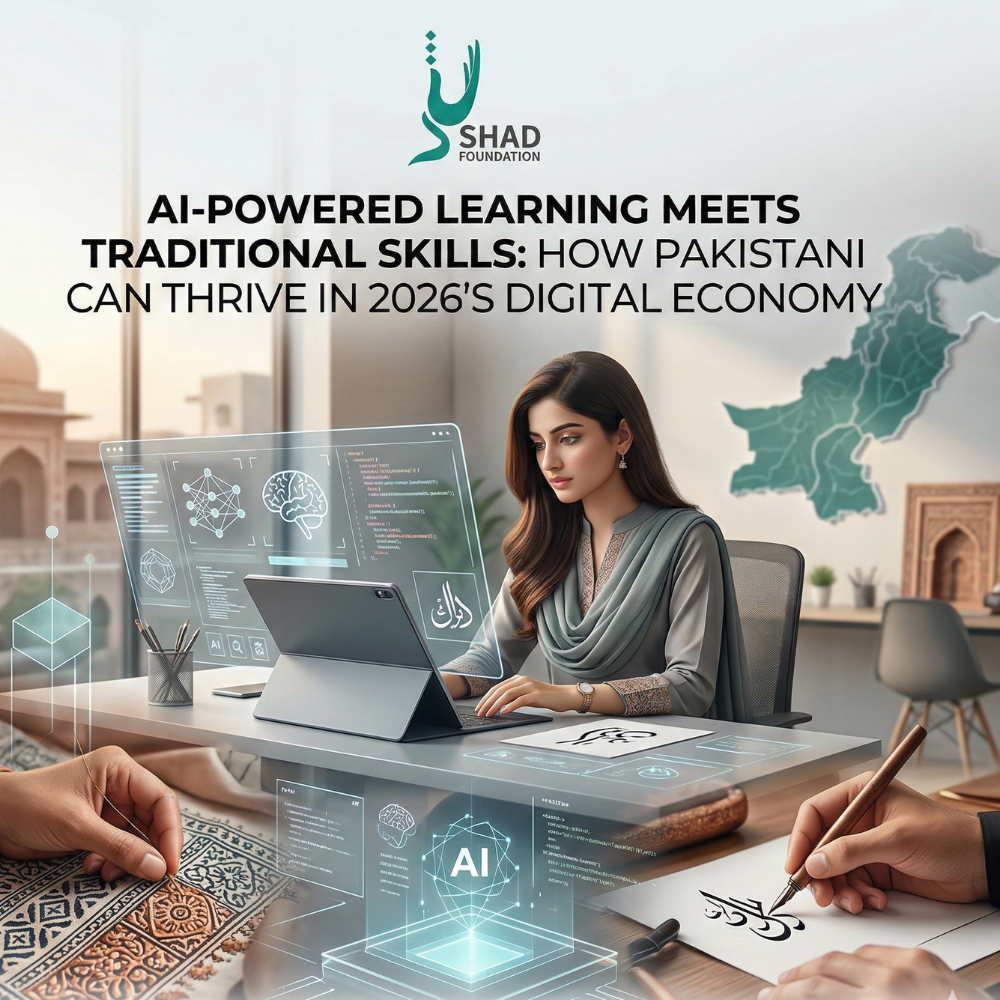
As artificial intelligence reshapes education globally, Pakistan’s youth face both unprecedented challenges and extraordinary opportunities. Here’s how smart skill development can bridge the gap between traditional education and tomorrow’s workforce.
The world of work has fundamentally changed. According to recent global education research, 86% of higher education students now use AI as their primary research partner, and 70% of job skills are expected to transform by 2030 due to AI’s impact. For Pakistan’s 140 million young people under 30, this isn’t just a trend—it’s a wake-up call.
The question isn’t whether AI will impact Pakistani youth, but whether they’ll be equipped to harness it or be left behind.
At SHAD Foundation, we’re witnessing this transformation firsthand. Our students are asking tough questions: “Will AI replace my job?” “How do I compete globally?” “What skills actually matter in 2026?” These aren’t abstract concerns—they’re the real anxieties of young people trying to build futures in an economy that’s evolving faster than ever before.
Here’s the sobering reality: while countries like India, Singapore, and South Korea are investing billions in AI education and skills training, Pakistan faces a critical skills mismatch. Most of our educational institutions emphasize theory over practice, leaving graduates unprepared for real-world demands. The result? Talented youth remain underemployed, frustrated, and increasingly looking abroad for opportunities.
But here’s the opportunity: Pakistan’s youth bulge—64% of our population under 30—isn’t a burden. It’s potentially our greatest economic asset. Countries that successfully channel young populations into skilled workforces experience decades of prosperity. Those that don’t face decades of instability.
The difference lies in one word: skills.
The OECD’s recent Digital Education Outlook reveals something fascinating: AI doesn’t eliminate the need for human skills—it makes them more valuable. While AI can write essays and generate code, it cannot replace critical thinking, creativity, ethical judgment, emotional intelligence, and collaborative problem-solving.
This is crucial for Pakistani youth to understand. The future belongs not to those who can compete with AI, but to those who can work alongside it effectively.
Skills that are gaining value in 2026:
Digital Literacy Beyond Basics: Knowing how to use a computer isn’t enough anymore. Today’s youth need to understand AI tools, evaluate digital information critically, protect their data privacy, and navigate online professional environments.
AI Collaboration Skills: Rather than fearing AI, successful young professionals are learning to use it as a partner. This means understanding prompt engineering (how to communicate effectively with AI), recognizing AI limitations and biases, verifying AI-generated information, and combining AI efficiency with human creativity.
Adaptability and Continuous Learning: With technology evolving monthly, not annually, the ability to learn, unlearn, and relearn has become the most valuable skill of all.
Human-Centered Skills That AI Can’t Replicate: Empathy and emotional intelligence, cultural competence in diverse teams, ethical decision-making, negotiation and conflict resolution, and authentic relationship building.
Technical Skills With Market Demand: Data analysis and interpretation, digital marketing and content creation, basic coding and software literacy, project management, and financial literacy for the digital economy.
Pakistan’s education system produces thousands of graduates annually, but a significant gap exists between what they learn and what employers need. According to recent data, Pakistan must generate over a million jobs yearly just to maintain current employment levels. But job creation alone isn’t enough—these jobs must match the skills our youth actually possess.
This is where organizations like SHAD Foundation play a crucial role. We don’t just provide accommodation for female students; we offer holistic development that bridges the academic-practical divide through:
Market-Aligned Skill Training: Our computer literacy programs aren’t about memorizing software features—they’re about building real-world competencies that employers value. We teach students how to use digital tools for research, collaboration, and professional communication.
Career Counseling That Addresses 2026 Realities: We help young women understand emerging career paths, including freelancing and remote work opportunities, digital entrepreneurship, hybrid careers combining multiple skills, and roles that don’t yet exist but will emerge soon.
Soft Skills Development: Technical knowledge alone won’t secure employment. Our students develop communication and presentation skills, time management and self-discipline, teamwork in diverse environments, and professional etiquette for digital workplaces.
Mental Health and Resilience Support: The pressure facing today’s youth—unemployment anxiety, family expectations, rapid change, economic uncertainty—requires more than just skills training. We provide psychological support to help students manage stress, build confidence, and maintain motivation.
Recent global surveys reveal interesting tensions. While 92% of students now use AI for learning, 70% of teachers worry it weakens critical thinking and research skills. In Pakistan, where AI adoption is still emerging, we have a unique opportunity to implement it thoughtfully rather than reactively.
The SHAD Foundation Approach to AI Integration:
We believe AI should enhance, not replace, human learning. Here’s how we’re preparing students:
Critical AI Literacy: Teaching students to question AI outputs, verify information from multiple sources, understand bias in AI systems, and recognize when human judgment is essential.
Ethical AI Use: Helping students understand plagiarism in the AI age, proper attribution and citation, balancing efficiency with integrity, and professional standards for AI use.
AI as a Learning Partner: Showing students how AI can help with concept clarification, practice problems and feedback, research starting points (not final sources), and language learning support.
Maintaining Human-Centered Learning: Ensuring students still engage deeply with complex texts, develop their own analytical frameworks, practice writing and communication, and build authentic connections with peers and mentors.
One of the most transformative opportunities for Pakistani youth is the global digital economy. Freelancing and remote work have eliminated geographical barriers that once limited career options to Karachi, Lahore, and Islamabad.
Pakistan already ranks among the top freelancing nations globally, but most freelancers work in low-value services with limited growth potential. The real opportunity lies in high-value skills:
Digital Skills with International Market Value: Web and app development, graphic design and UX/UI, content writing and copywriting, digital marketing and SEO, data analysis and visualization, and virtual assistance with specialized skills.
How SHAD Foundation Supports This Transition:
Our vocational training programs specifically target skills with international demand. We partner with successful freelancers and remote workers to provide mentorship, teach students how to build professional portfolios, navigate international payment systems, communicate with global clients, and manage work-life balance in remote careers.
For female students facing mobility constraints or safety concerns, freelancing offers unprecedented economic independence without requiring them to compromise their values or family commitments.
Pakistan ranks poorly on global gender equality indices, and the skills gap disproportionately affects young women. Cultural barriers, limited access to technology, safety concerns, and restricted mobility all compound the challenge of acquiring market-relevant skills.
Yet our experience at SHAD Foundation proves that when barriers are removed, young women excel remarkably. Our female students consistently demonstrate:
What Makes the Difference?
Creating safe, supportive environments where learning can flourish, providing role models and mentors who’ve walked similar paths, addressing practical barriers like accommodation and transportation, building confidence through incremental successes, and connecting skills to real economic opportunities.
When a young woman from a remote area gains digital skills and earns her first freelancing income, the impact extends far beyond her individual achievement. She becomes a role model for her siblings, a source of pride for her family, an economic contributor to her community, and proof that change is possible.
Individual effort alone won’t solve Pakistan’s skills gap. We need systemic change involving:
Government Action: Modernizing curricula to include AI literacy and digital skills, investing in vocational training infrastructure, creating bridges between education and industry, and supporting apprenticeship and internship programs.
Private Sector Engagement: Companies must invest in fresh talent through training rather than only hiring “ready-made” professionals, collaborate with training institutions on relevant curricula, offer internships and entry-level opportunities, and provide mentorship to young professionals.
Educational Institutions: Universities and training centers need to balance theory with practical application, integrate technology thoughtfully into teaching, provide career counseling and placement support, and measure success by employment outcomes, not just enrollment.
Civil Society Organizations: NGOs like SHAD Foundation fill critical gaps by reaching underserved populations, providing holistic support beyond just training, advocating for policy changes, and demonstrating what’s possible through innovation.
As we navigate 2026, SHAD Foundation remains committed to preparing youth—especially young women from marginalized communities—for the realities of today’s workforce. Our integrated approach combines:
Safe Residential Facilities: Removing the accommodation barrier that prevents many female students from pursuing education in cities where opportunities exist.
Comprehensive Skills Training: Going beyond basic computer literacy to include AI collaboration skills, digital entrepreneurship, professional communication, and financial literacy.
Career Development Support: Helping students identify career paths, build professional networks, create compelling portfolios, and navigate job searches or freelancing platforms.
Mental Health and Wellbeing: Recognizing that skills alone aren’t enough if students lack the emotional resilience to navigate challenges, setbacks, and rapid change.
Community Building: Creating peer networks where students support, inspire, and learn from each other—relationships that last far beyond their time at our centers.
The abstract concept of “skills development” becomes real when you meet students whose lives have transformed:
Ayesha from Chitral learned graphic design and now works with international clients, earning more than her family’s combined previous income while living at home.
Fatima from Rawalpindi completed our digital marketing training and now manages social media for three small businesses, building her portfolio toward launching her own agency.
Mariam from Islamabad used her IT skills to secure a remote position with a European tech company, proving that geography no longer determines destiny.
These aren’t exceptional cases—they’re what becomes possible when talent meets opportunity, when skills align with market demand, and when support systems remove barriers that previously seemed insurmountable.
For Students and Youth: Don’t wait for the perfect opportunity—start building skills now. Many resources are free or low-cost: online courses, YouTube tutorials, practice projects, and freelancing platforms. Focus on one or two high-value skills rather than superficial knowledge of many. Build a portfolio showcasing your work. Seek mentors in your desired field. Stay updated on industry trends and emerging technologies.
For Parents and Families: Support your daughters’ educational and career aspirations. Skills development isn’t a luxury—it’s a necessity for economic survival in 2026. Encourage continuous learning beyond formal education. Help young people access training opportunities and safe learning environments. Celebrate incremental progress, not just final outcomes.
For Potential Partners and Supporters: Organizations, businesses, and individuals committed to youth development can multiply their impact through SHAD Foundation. Your support enables more students to access training, better facilities and equipment, expanded program offerings, and stronger placement support.
For Policymakers and Institutions: Invest in infrastructure that enables skills development. Create policies that incentivize industry-academia collaboration. Remove regulatory barriers to freelancing and remote work. Measure educational success by employment outcomes.
Pakistan stands at a crossroads. We have one of the world’s youngest populations at precisely the moment when global skills demands are shifting dramatically. This convergence creates either unprecedented opportunity or deepening crisis—the outcome depends on choices we make today.
The cost of inaction is clear: continued youth unemployment, brain drain as talented individuals seek opportunities abroad, missed economic growth potential, and social instability from frustrated, unemployed youth.
But the potential of action is equally clear: economic growth driven by a skilled workforce, reduced poverty through better employment, increased global competitiveness, and social stability through opportunity and inclusion.
At SHAD Foundation, we’re not waiting to see which future unfolds. We’re actively building the future we want to see—one where every young person, regardless of gender or geography, has the skills and support to thrive in the modern economy.
The skills revolution isn’t happening to Pakistani youth—it’s happening with them. Every day, young people across Pakistan are learning, adapting, and building futures that previous generations couldn’t imagine.
SHAD Foundation invites you to be part of this transformation:
The future of Pakistan depends on how effectively we prepare our youth for the world they’ll inherit. That world requires new skills, new mindsets, and new support systems. At SHAD Foundation, we’re building all three.
Join us in empowering Pakistan’s next generation—not with promises, but with practical skills, real opportunities, and unwavering support.
About SHAD Foundation
SHAD Foundation (Social Help Advocacy and Development) is an Islamabad-based non-profit organization dedicated to youth empowerment, education, and community development. We operate Youth Development Centers in partnership with Hashoo Foundation, providing safe accommodation, skills training, and holistic support for young women pursuing education and careers.
Get Involved:
Connect With Us: Follow SHAD Foundation on social media for success stories, program updates, skills development tips, career guidance resources, and opportunities to get involved.
Together, we can ensure Pakistan’s youth don’t just survive the AI age, they thrive in it.